
The Quiet Seduction of Paper and Pen
Evening gathers at the window while a candle steadies its small flame. A weathered sheet unfolds across the table, carrying the faint scent of cedar, dry paper, and fountain-pen ink. The handwriting is not merely a record of thought. It is evidence of time willingly spent, each loop and pause revealing the pressure of a hand that could have chosen speed but chose presence instead.
Modern romance moves at the pace of notification. A message appears, receives a heart, disappears beneath newer messages, and leaves behind the uneasy impression that intimacy must remain constantly visible to remain alive. A letter asks for something else. It asks the writer to wait, the recipient to imagine, and both lovers to inhabit the interval between sending and receiving.
That interval is where the deeper work begins. Physical correspondence becomes an emotional architectural blueprint, giving vulnerable thoughts a structure that spontaneous dialogue often lacks. In the quiet choreography of drafting, revising, folding, and waiting, lovers discover that intimacy is not only an exchange of information. It is the deliberate construction of a private world sturdy enough to outlast the moment in which it was spoken.
Unfolding the Architecture of Longing
The literary history of romance understood this power early. From Aphra Behn”s seventeenth-century fiction to the great correspondence-driven narratives of the eighteenth century, letters created a private theater in which desire could develop away from the immediate pressures of society. Behn”s Love Letters Between a Nobleman and His Sister drew on scandal, secrecy, and social danger, while later works such as Pamela used letters to frame moral struggle and personal self-narration. The form allowed readers to approach a character”s inner life as if they had been entrusted with a confidential bundle of papers.
The classic epistolary novel is distinctive precisely because correspondence feels both intimate and incomplete. A letter does not provide an omniscient narrator or a perfectly balanced account. It offers a voice, a perspective, a particular moment of self-presentation. Readers must notice omissions, evasions, changes in tone, and the emotional meaning of what remains unsaid. For a useful account of how this tradition shaped Western narrative, consult this history of the epistolary novel.
The physical act of writing intensifies that illusion of truth. Folding a page, pressing wax over its closure, addressing an envelope, and carrying it to the post transforms ordinary speech into a small ceremony. The words become portable but not weightless. They acquire a journey, a delay, and a destination. Jane Austen”s letter from Captain Wentworth in Persuasion remains memorable because its compressed urgency feels like emotion finally breaking through restraint. In Dangerous Liaisons, correspondence becomes seduction, manipulation, and strategy at once. In the real letters of writers such as Vita Sackville-West and Virginia Woolf, longing appears not as a polished romantic pose but as a fluctuating, sometimes contradictory human force.
The Psychology of Stripped Social Armor
Spoken conversation rewards immediacy. A raised eyebrow, a pause, or a change in volume can redirect the exchange before a difficult truth has fully formed. Writing removes those escape routes. The blank page does not hurry the writer toward reassurance, wit, or a socially acceptable answer. It holds still while an uncomfortable sentence is attempted, crossed out, and attempted again.
That solitude can lower the defenses people carry into face-to-face romance. A writer may admit fear of abandonment, gratitude for an unnoticed kindness, or a desire that feels too exposed when spoken aloud. Handwriting also preserves the person behind the words. Uneven spacing, ink blots, cramped margins, and changes in pressure make the message bodily in a way that a polished screen rarely is. Archival letters, including preserved personal correspondence such as C. S. Lewis”s letters to Florence Schweizer, demonstrate how material details can become part of the emotional record.
| Dimension | Spoken romance | Written romance |
|---|---|---|
| Pace | Immediate and responsive | Delayed and reflective |
| Emotional control | Shaped by facial cues and social pressure | Shaped through drafting and revision |
| Sensory presence | Voice, gesture, proximity | Paper, handwriting, ink, and the trace of touch |
| Memory | Often reconstructed later | Preserved as a tangible artifact |
| Vulnerability | Can emerge spontaneously | Can be approached deliberately and privately |
This does not make written intimacy automatically more honest than speech. A letter can be theatrical, evasive, or manipulative, just as conversation can be tender and truthful. Its particular gift is the opportunity to meet one”s own thought before offering it to another person. That reflective pause creates room for precision. Instead of saying, “You are wonderful,” a writer can remember the exact morning a partner noticed a small worry, made tea, or protected an hour of quiet.
For that reason, letters should not be treated as a test of literary talent. The most affecting correspondence is often plain. A sentence with an ordinary verb can carry enormous weight when it names something specific and true. “You make difficult days feel navigable” may matter more than a page of ornamental praise, because it describes not an idealized image but the lived effect of the relationship.
From Vellum Scrolls to Late-Night Glow
The epistolary impulse has survived every change in communication technology. Wartime letters carried affection across dangerous distances, often combining domestic details with fear, longing, and practical news. Telegrams compressed feeling into costly fragments. Later, typewritten letters and long-distance telephone calls altered the texture of separation without eliminating the desire to leave a durable record. By the late twentieth century, email restored some of the letter”s extended form, even as it removed the envelope, the handwriting, and much of the wait.
Early-2000s email romances made the transition especially visible. Meg Cabot”s The Boy Next Door, told entirely through email exchanges, uses the format for mistaken identity, romantic entanglement, and the particular intimacy of a message arriving in a young digital culture. Contemporary recommendations also include Attachments, An American Marriage, The Flatshare, and This Is How You Lose the Time War. In The Undertaking of Hart and Mercy, anonymous letters allow two antagonistic characters to reveal tenderness to one another while remaining hostile in person.
Texts and direct messages inherit the confessional DNA of classical letters. They can hold secrets, private jokes, sudden declarations, and the emotional charge of rereading. Yet their abundance changes the experience. A message can be sent before an emotion has matured, answered before its meaning has settled, and buried beneath an endless stream of updates. The form remains intimate, but the stillness has thinned.
The historical structure remains recognizable because private disclosure still shapes both popular romance and personal expression. An overview of the form”s development can be found in this guide to epistolary narrative. Digital adaptations preserve the framing device, but the strongest examples also preserve its deeper principle: a correspondence should reveal what ordinary social performance conceals.
Curating an Atmosphere of Thoughtful Romance
Reintroducing handwritten intimacy does not require a grand retreat or a collection of antique furniture. A quiet evening at home can become a carefully designed romantic escape when the pace is protected. Set phones aside for an agreed period, prepare a warm drink, lower the lighting, and place writing materials where they feel inviting rather than ceremonial. The objective is not to imitate another century perfectly. It is to give attention a physical setting.
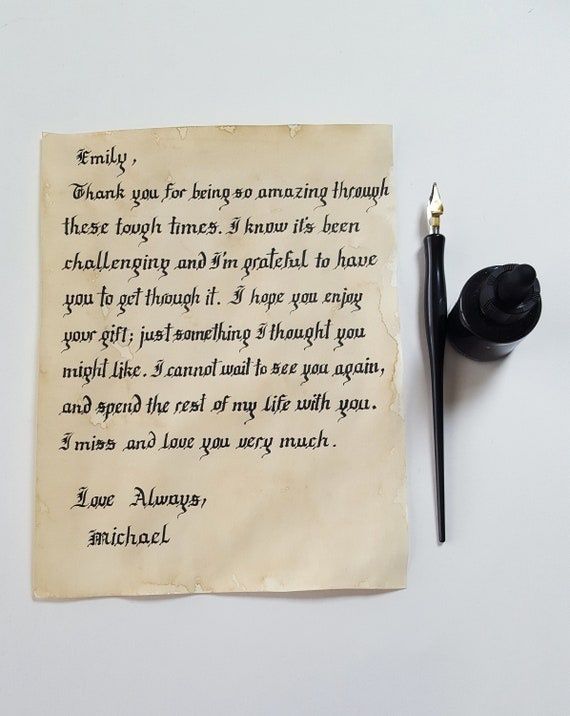
Choose textured cotton paper that feels substantial without becoming difficult to write on. A reliable archival ink in deep blue, brown, or black offers a richer visual finish than disposable ballpoint ink, while a simple fountain pen can make the act feel more deliberate. Wax sealing is an attractive final gesture, but it should remain optional, especially if the letter will be posted. A folded sheet tied with narrow ribbon or placed in a small envelope can be just as evocative.
- Begin with ten uninterrupted minutes of writing rather than trying to produce a perfect letter.
- Describe one precise moment when your partner made life gentler, braver, or more beautiful.
- Name a future ritual you would like to share, such as a yearly walk, a seasonal meal, or a private anniversary tradition.
- Write about a quality in your partner that becomes clearer over time, rather than offering only immediate compliments.
- Seal the letter and agree on when it will be opened, allowing anticipation to become part of the experience.
Prompts can guide the evening beyond surface praise. Consider these questions: Which ordinary detail of our life would you preserve if everything else disappeared? What have you learned about yourself because of this relationship? Which version of the future feels quietly exciting rather than merely impressive? When have you felt most understood? Such questions encourage poetic reflection while remaining grounded in shared experience.
For a romantic getaway, letters can be placed in a suitcase to be opened on different days, or written separately after a shared dinner and exchanged before sleep. At home, one partner might write beside a window while the other prepares dessert, creating companionship without conversation. The luxury lies in the protected attention, the tactile materials, and the knowledge that neither person is trying to perform for an audience.
Claiming Your Own Legacy of Ink
Written correspondence changes romance by giving emotion somewhere to remain. A spoken promise lives vividly in memory, but a letter can be revisited during an ordinary Tuesday, a difficult season, or many years after the circumstances that inspired it have passed. It preserves not only what was felt, but how carefully one person tried to make that feeling understood.
Step away from the glowing screen, choose a sheet of paper, and begin with a detail only the two of you would recognize. The result does not need to be eloquent, antique, or perfectly sealed. It needs to be deliberate. In an age of instant contact, a handwritten letter is an accessible luxury of devotion, a small tangible artifact declaring that the relationship deserves time, thought, and a place in the physical world.